Places
Things to Do in Yosemite: Viewpoints, Waterfalls, Giant Sequoias and More
Yosemite is not one place but several. Yosemite Valley holds the famous cliffs and waterfalls and is open by car all year. Glacier Point looks down on it from the rim. The Mariposa Grove shelters giant sequoias near the South Entrance. The Tioga Road climbs to Tuolumne Meadows in the high country, and Hetch Hetchy hides a second, quieter valley in the northwest. Over four million people visit each year, and most of them never leave the Valley floor.
That is a pity, because the best things to do in Yosemite are spread across the park and across the seasons. This list follows the National Park Service’s own pages: what to see, where it is, when it is open, and how much time it takes. If walking is your priority, our guide to hiking in Yosemite goes trail by trail; if you are choosing dates, start with Yosemite weather by month.
Stop at Tunnel View
Tunnel View is the picture of Yosemite most people know before they arrive. It sits at the east end of the Wawona Tunnel on the Wawona Road (Highway 41), and from it you see El Capitan and Bridalveil Fall rising from the Valley, with Half Dome in the background. It is a roadside stop, so even a few minutes here is worth it.
If you come in on Highway 120 from the west instead, the turnouts near the tunnels on the Big Oak Flat Road give a view of El Capitan and Half Dome with a glimpse of the Merced River far below. Two miles up the Glacier Point Road from Chinquapin, El Portal View looks down the Merced River canyon toward the Coast Ranges on a clear day.
Look up at El Capitan and Half Dome
Yosemite is a granite park. The park says more than 90% of its landscape is granitic rock, most of it formed in the Cretaceous between 105 and 85 million years ago, deep underground, before erosion and glaciers exposed it. The geology page points to the vertical face of El Capitan, rising 3,000 feet above the floor of Yosemite Valley, as proof of the rock’s strength and lack of fractures. It was mapped in detail only between 2011 and 2013, when a team of geologists completed the first geologic map of the sheer southeast face, partly by climbing it.
The best places to look up from the Valley floor, all on the park’s list of viewpoints:
- El Capitan Meadow for a view straight up El Capitan and across to Cathedral Rocks. It is on one-way Northside Drive, so the park suggests stopping on your way out of the Valley.
- Valley View, beside the Merced River just before Pohono Bridge, for the classic look up the Valley.
- Sentinel Bridge, famous for Half Dome reflected in the Merced River, with Yosemite Falls nearby.
- Sentinel Meadow and the Yosemite Chapel for Yosemite Falls.
Half Dome itself rises nearly 5,000 feet above the Valley to 8,800 feet above sea level. Its sheer face, like the Royal Arches, was shaped by sheets of granite peeling away, and rockfall is still the most active geological process in the park: the park’s records show more than 1,000 rockfalls over the past 150 years.
Watch the climbers
The park calls Yosemite one of the world’s greatest climbing areas, from crack climbs in the Merced River Canyon to domes in Tuolumne Meadows and multi-day climbs on the big walls of the Valley. After dark, in the spring and fall climbing seasons, the park notes that climbers’ headlamps switch on across the cliffs as the first stars come out. It is a serious sport: more than 100 climbing accidents happen in Yosemite each year, and 15-25 parties need a rescue. If you want to try it, the park points to the Yosemite Mountaineering School and Guide Service for lessons.
Chase the waterfalls
Yosemite is home to countless waterfalls, and the park says it has so many mainly because of glaciers, which deepened the main valleys and left the side streams hanging high above them. Bridalveil, Yosemite, Sentinel and Ribbon falls are all hanging waterfalls of this kind. The best time to see them is spring, when peak runoff typically comes in May or June.
The park’s heights and seasons for the best known:
| Waterfall | Height | Flows | Where to see it |
|---|---|---|---|
| Yosemite Falls | 2,425 ft in three parts | About November through July | Yosemite Village, the Lodge, Lower Yosemite Fall trail |
| Sentinel Falls | About 2,000 ft | About March through June | Southside Drive near Sentinel Beach |
| Ribbon Fall | 1,612 ft | About March through June | From the road entering the Valley |
| Wapama Falls | 1,400 ft | All year | O’Shaughnessy Dam, Hetch Hetchy |
| Horsetail Fall | 1,000 ft | About December through April | East of El Capitan, in winter |
| Bridalveil Fall | 620 ft | All year | Its own parking area and short trail |
| Nevada Fall | 594 ft | All year | Glacier Point, or the Mist Trail |
| Illilouette Fall | 370 ft | All year | Only from steep trails, best the Panorama Trail |
| Vernal Fall | 317 ft | All year | Glacier Point, or the Mist Trail |
Yosemite Falls is really three falls: Upper Yosemite Fall (1,430 feet), the middle cascades (675 feet) and Lower Yosemite Fall (320 feet). The short loop to the base of the lower fall is the easiest close-up in the park. By August it can be a trickle or completely dry, which is why a summer or fall visitor may find the Valley’s most famous waterfall missing.
Horsetail Fall deserves its own note. On rare evenings in mid- to late February, when the sky is clear and the fall is flowing, the setting sun turns it glowing orange. The crowds grew so large (2,433 people gathered to watch on February 19, 2022) that viewing restrictions now apply each February, with a 1.5-mile walk each way from Yosemite Falls parking to the viewing area.
Drive up to Glacier Point
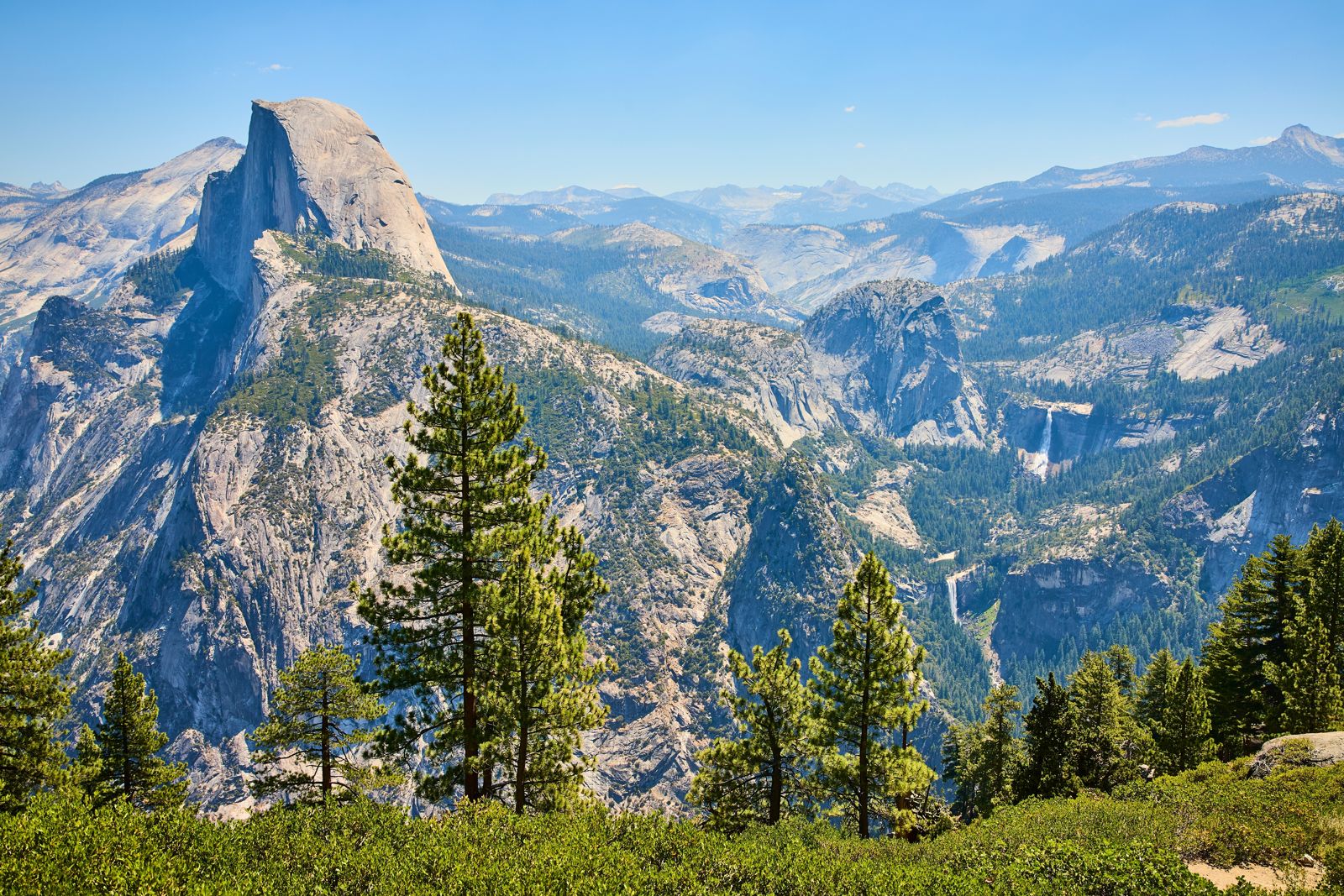
Glacier Point is the overlook that, in the park’s words, some would say is the most spectacular viewpoint anywhere. A short, paved, wheelchair-accessible path leads from the parking area to a railing 3,214 feet above Curry Village on the Valley floor, with Half Dome, Yosemite Falls and the high country spread out in front. Just south, Washburn Point has a more direct view of Vernal and Nevada Falls, plus Illilouette Fall.
Getting there takes planning. Glacier Point is 30 miles, about an hour’s drive, from either Yosemite Valley or Wawona: take the Wawona Road for about 13 miles and turn onto the Glacier Point Road at the Chinquapin intersection. The road is open to cars from approximately late May to October or November. There is no regular shuttle; in summer the concessioner’s Glacier Point tour bus runs from the Valley, and one-way tickets let you ride up and hike down by the Four Mile or Panorama Trail.
History is part of the view. The Washburn brothers funded the original Glacier Point Road in 1882, and in 1903 President Theodore Roosevelt passed this way on a three-day wilderness trip with John Muir that ran from the Mariposa Grove to Sentinel Dome, Glacier Point and the Valley. In summer, amateur astronomy clubs hold star parties at the Glacier Point Amphitheater from 8:30 pm, typically lasting 2 to 4 hours. In winter the road beyond Badger Pass is groomed, and cross-country skiers can ski 10.5 miles to the point.
Walk among the giant sequoias
The Mariposa Grove is the largest sequoia grove in Yosemite, with over 500 mature giant sequoias, and it is where the national park idea began. In 1864 President Lincoln signed legislation protecting the grove and Yosemite Valley for public use, in the middle of the Civil War; the grove was added to Yosemite National Park in 1906. It closed in spring 2015 for a major restoration and reopened on June 15, 2018.
How to visit:
- Shuttle: a free shuttle runs from the Mariposa Grove Welcome Plaza near the South Entrance, with buses about every 15 minutes. The plaza has about 300 parking spaces and can fill by late morning. In 2026 the shuttle ran 8 am to 7 pm from May 3 through September 23, and 8 am to 5:00 pm from September 24 through October 31, weather permitting.
- Driving: the grove road is open only to vehicles with a disability placard.
- Winter: with no shuttle, you walk the Washburn Trail, two miles each way with about 500 feet of climb.
Inside the grove, the wheelchair-accessible Big Trees Loop takes 30 to 45 minutes past the Fallen Monarch. The Grizzly Giant Loop, 2 miles and 1.5 to 2 hours, passes the Bachelor and Three Graces, the California Tunnel Tree and the 3,000-year-old Grizzly Giant itself. Wawona, also near the South Entrance, is home to the historic Wawona Hotel and the Yosemite History Center.
Drive the Tioga Road to Tuolumne Meadows
In summer the Tioga Road offers a 47-mile scenic drive between Crane Flat and Tioga Pass, through forests and past meadows, lakes and granite domes. It is open approximately late May or June through October or November, and when it is closed you cannot reach the high country by car. The stops worth making:
- Siesta Lake, about 13 miles east of the Crane Flat gas station, a small lake by the road for a picnic.
- Olmsted Point, at about 8,400 feet, looks at Half Dome from the east, along with Tenaya Lake and Clouds Rest. A 0.25-mile walk leads out onto the point past glacial erratics, boulders the ice carried and dropped. The park recommends it at sunset.
- Tenaya Lake, the largest lake in Yosemite’s frontcountry, ringed by granite domes and popular for picnics, swimming and kayaking.
- Tuolumne Meadows, at 8,600 feet one of the largest high-elevation meadows in the Sierra Nevada, with the Tuolumne River winding through it.
- Soda Spring and Parsons Memorial Lodge, an easy walk across the meadow to carbonated water bubbling out of the ground and the lodge marking where John Muir and Robert Underwood Johnson conceived the idea of Yosemite National Park. The lodge opens from late June to early September.
- Lembert Dome, a short, steep climb for a view over the meadows.
There is no gas in Tuolumne Meadows, and services may be limited early and late in the season, so fill up at Crane Flat or Lee Vining.
Visit Hetch Hetchy
Hidden in the park’s peaceful northwest corner, Hetch Hetchy is a second valley, today holding the Hetch Hetchy Reservoir behind O’Shaughnessy Dam. From the parking lot at O’Shaughnessy Dam you can see its waterfalls and cliffs; Wapama Falls, 1,400 feet tall and at its peak in May, is visible from the dam, and the trail along the shore leads to footbridges near its base. The Hetch Hetchy Road is open all year but only from sunrise to sunset, and it closes when snow is falling or forecast overnight. Swimming and boating in the reservoir are prohibited, to keep the drinking water clean.
Get on the water
On hot summer days the Merced River is the Valley’s playground.
- Rafting: rafts can be rented, typically in June and July depending on water level, or bring your own. Most people put in at Stoneman Bridge near Curry Village and take out at Sentinel Beach Picnic Area. The river is open to boating only when the gage at Pohono Bridge is below 7 feet at 8 am, and children under 13 must wear a life jacket.
- Swimming: allowed in most of the park’s waters, entering only from sandy beaches on the Merced. It is prohibited in Emerald Pool and the Silver Apron above Vernal Fall, and in Hetch Hetchy Reservoir. In summer, Curry Village and Yosemite Valley Lodge have outdoor pools open to the public.
- Kayaking: Tenaya Lake’s calm water is the favorite.
- Fishing: anglers 16 or older need a valid California fishing license, and rainbow trout in the rivers are catch and release only.
Rivers are cold and fast, especially in spring. The park’s safety pages warn again and again about slippery rocks and strong currents near waterfalls.
Bike the Valley
Yosemite Valley has over 12 miles of paved bike paths with a 15 mph speed limit, and cyclists may also ride on the park roads if they obey traffic laws. Bikes can be rented at Curry Village, Yosemite Village and Yosemite Valley Lodge on a first-come, first-served basis, and a free bike share allows short trips of up to two hours in the Valley. Helmets are required by law for children under 18. Off the Valley floor, the Wawona Meadow Loop is the only hiking trail in the park where bicycles are allowed.
Learn the human story
Yosemite’s history is close at hand in Yosemite Village and beyond:
- Yosemite Museum: the first building constructed as a museum in the national park system, opened to the public on May 29, 1926. Its Indian Cultural Exhibit interprets the cultural history of Yosemite’s traditionally associated tribes, with demonstrations of traditional skills.
- Yosemite Exploration Center (formerly the Valley Visitor Center): open all year, with the Spirit of Yosemite film and exhibits on geology, wildlife, history and climbing.
- Yosemite Chapel: the oldest structure in Yosemite Valley, with services since June 7, 1879, built in a New England style to seat 250.
- Happy Isles Art and Nature Center: open May to September and designed for families; evidence of the huge 1996 rockfall from Glacier Point is visible above it.
- Parsons Memorial Lodge in Tuolumne Meadows, tied to the founding of the park.
The park also runs ranger-led walks and talks through much of the year; check the park calendar for what is on during your visit. Birdwatchers have plenty to look for, with over 165 species of migrating, wintering and breeding birds.
Stay out after dark
Yosemite keeps light pollution low, and the night sky is one of its quiet wonders. The park’s tips:
- The Milky Way: its core is easily visible on moonless nights from July through October.
- Moonbows: on full-moon nights in peak waterfall season, April to June, moonlight makes rainbows in the mist of Upper and Lower Yosemite Falls.
- Timing: the sky is darkest from about 1.5 hours after sunset to 1.5 hours before sunrise. Give your eyes 20 to 30 minutes without white light, and use a red light.
- Where: El Capitan Meadow, Cook’s Meadow, Tunnel View, Glacier Point, Olmsted Point and Tenaya Lake are all on the park’s list.
Remember that sleeping in your car is only allowed in a campsite you have reserved, so plan where you will spend the night.
Play in the snow
Winter turns Yosemite into a snow park, and some activities exist only then:
- Badger Pass Ski Area, the oldest downhill skiing area in California, runs from mid-December through March, conditions permitting. The West’s first ski lift, the Upski, was built there in 1933, and the historic lodge opened in 1935. There is snow tubing, but sledding is not allowed.
- Snowshoeing and cross-country skiing: marked winter routes generally have enough snow from mid-to-late December through mid-March. Rangers may lead free snowshoe walks from Badger Pass.
- Ice skating: the outdoor Curry Village Ice Rink, open from mid-November to mid-March, skates in the shadow of Half Dome. The first rink there was built in 1929, when Yosemite hoped to host the 1932 Winter Olympics.
- Horsetail Fall in February, if the sky is clear.
In winter, carry tire chains: the park says to expect chain requirements from November through March, even for the Valley.
Putting a day together
With one day, most visitors stay in Yosemite Valley: Tunnel View on the way in, Bridalveil Fall, Lower Yosemite Fall, a stroll through Cook’s Meadow and Sentinel Bridge, and El Capitan Meadow and Valley View on the way out. Arrive before 9 am, when the park says Valley parking is usually full, and use the free shuttle once you have parked.
With a second day in summer, add Glacier Point in the afternoon or the Tioga Road to Olmsted Point, Tenaya Lake and Tuolumne Meadows. Coming from the south, put the Mariposa Grove at the start or end of the trip. Guided trips can combine several of these in one day; the park concessioner’s eight-hour Grand Tour, for example, visits Yosemite Valley, Glacier Point and the Mariposa Grove. Our comparison of Yosemite tours sets the day trips side by side, our guide to Yosemite from San Francisco covers the drive, and the FAQ covers entry and reservations.
Frequently asked questions
What is the most famous view in Yosemite?
Tunnel View, at the east end of the Wawona Tunnel on Highway 41, with El Capitan, Bridalveil Fall and Half Dome in one frame. Glacier Point, 3,214 feet above Curry Village, is the other contender; the park says some would call it the most spectacular viewpoint anywhere.
Can you see giant sequoias in Yosemite?
Yes. The Mariposa Grove near the South Entrance has over 500 mature giant sequoias, including the 3,000-year-old Grizzly Giant. A free shuttle runs from the welcome plaza from spring to fall; in winter you walk in on the Washburn Trail.
What can you do in Yosemite in one day?
Stay in Yosemite Valley: Tunnel View, Bridalveil Fall, Lower Yosemite Fall, Cook’s Meadow and Sentinel Bridge, El Capitan Meadow and Valley View. In summer, add Glacier Point, about an hour’s drive from the Valley.
What is there to do in Yosemite in winter?
Skiing, snowboarding and snow tubing at Badger Pass from mid-December through March, snowshoe walks, ice skating at Curry Village from mid-November to mid-March, and Horsetail Fall in February. The Valley stays open, but the Tioga and Glacier Point roads are closed to cars.
Can you swim in Yosemite?
In most waters, yes, including the Merced River, entering from sandy beaches. Swimming is prohibited in Emerald Pool and the Silver Apron above Vernal Fall and in Hetch Hetchy Reservoir. Curry Village and Yosemite Valley Lodge have public outdoor pools in summer.